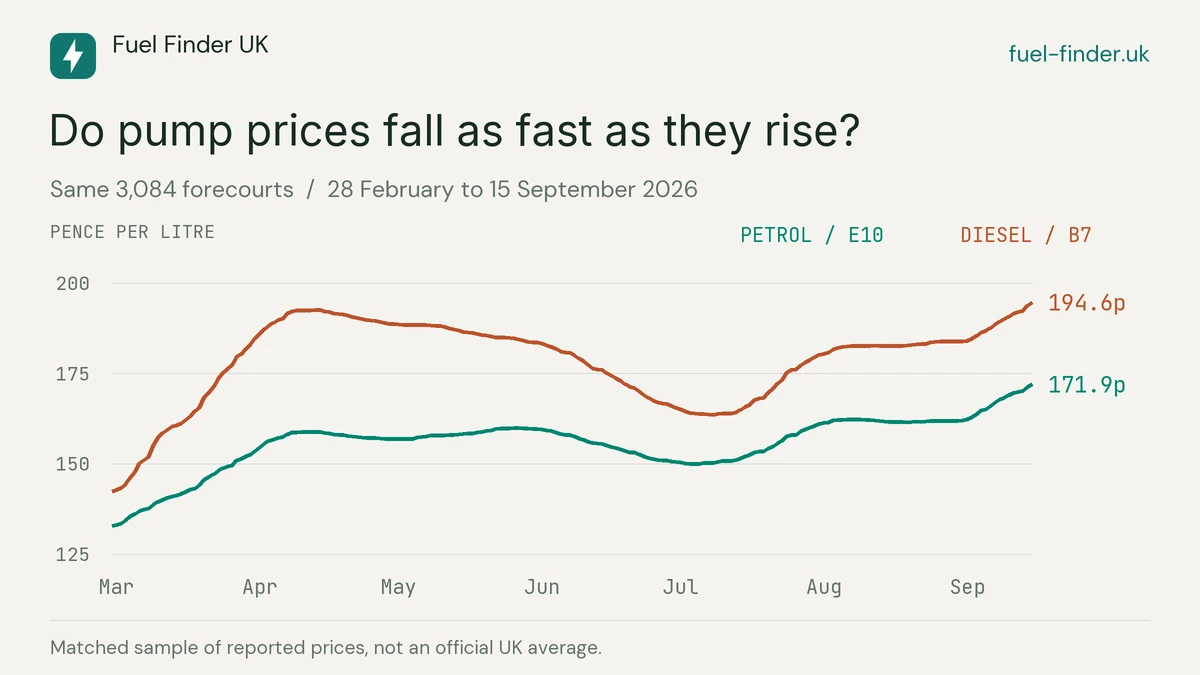
UK forecourts changed petrol and diesel prices at an extraordinary pace during the first three weeks of September.
Fuel Finder's retained price history recorded 100,540 price rises between the start of 1 September and 10am on 22 September 2026. Over the same period, it recorded 4,861 reductions. That means there were more than 20 increases for every reduction in this dataset.
This is not a count of 100,000 petrol stations. It is a count of individual price-change events. One forecourt can change petrol and diesel separately and can alter either price more than once. Even with that distinction, the figures show how broad and persistent the movement has been.
Prices changed across almost the whole market
The rises were split between 53,288 diesel changes and 47,252 petrol changes. They were not confined to a small number of particularly active sites:
- 7,861 forecourts recorded at least one diesel increase.
- 7,741 forecourts recorded at least one petrol increase.
- 20,947 individual increases were 3p per litre or more.
The median increase was 2p per litre for diesel and 1p for petrol. The averages were slightly higher, at 2.11p for diesel and 1.97p for petrol, because some larger jumps pulled the figures upwards.
| Fuel | Rises | Reductions | Median rise | Rises of 3p+ |
|---|---|---|---|---|
| Petrol | 47,252 | 2,431 | 1p | 8,636 |
| Diesel | 53,288 | 2,430 | 2p | 12,311 |
| Combined | 100,540 | 4,861 | Not combined | 20,947 |
The busiest days for price rises
The changes arrived in waves rather than at a steady daily rate. Fuel Finder recorded 4,228 diesel increases on 14 September alone, the busiest diesel day in the period. Petrol's busiest day was 7 September, with 3,684 increases.
On that petrol peak, the average individual rise was 2.44p per litre and 987 of the increases were at least 3p. The same day also brought 3,759 diesel increases, so drivers could see both prices change at many forecourts within a short window.
That matters in practice. A station that was competitive a few days earlier may no longer be the cheapest option nearby. During a fast-moving market, an old price is less useful than the latest reported comparison.
The rise spread through the market in days
The event count shows activity; a fixed group of stations shows how widely the movement spread. Among forecourts with a comparable standard-fuel price at both the start of 1 September and 10am on 22 September, 97.5% raised petrol and 97.4% raised diesel. Fewer than 0.2% ended the period lower.
The repricing was also rapid. Of stations that eventually recorded an increase, 74.2% of diesel sites and 76.9% of petrol sites had done so by 4 September. By 11 September the proportions were 96.8% and 97.2% respectively.
Petrol and diesel did not always move together. Across 7,626 forecourts that raised both fuels, the first increases were recorded at exactly the same time at 51.3%. Petrol moved first at 29.0% and diesel at 19.7%. Where the first changes were not simultaneous, the median gap was 25.2 hours and one in ten gaps exceeded five days. That is a useful warning against treating a forecourt as a single price: the two products can reprice on different schedules.
What happened to the national average?
The weekly averages moved in the same direction. Fuel Finder's Fuel Price Pulse uses one closing price per station, carries that price forward until it changes and compares a like-for-like weekly group.
| Week ending | Petrol | Diesel | Seven-day change |
|---|---|---|---|
| 30 August | 161.6p | 183.4p | Petrol +0.4p; diesel +0.9p |
| 6 September | 164.8p | 186.4p | Petrol +3.2p; diesel +3.0p |
| 13 September | 169.3p | 191.3p | Petrol +4.5p; diesel +4.9p |
| 20 September | 172.2p | 195.9p | Petrol +2.9p; diesel +4.6p |
Across those three September weeks, the weekly petrol average rose 10.6p per litre and diesel rose 12.5p. The latest Fuel Finder UK Fuel Price Index snapshot at 8:48am on 24 September put current accepted reports at 173.5p for petrol and 197.9p for diesel. Current snapshots and weekly series use different inclusion rules, so they should not be treated as interchangeable measures.
The official Department for Energy Security and Net Zero series tells the same broad story. Its averages for the week beginning 21 September were 172.01p for petrol and 195.53p for diesel, weekly increases of 3.9p and 4.8p. The government publishes that series as accredited official statistics.
What a fixed station cohort shows
Weekly averages can change when stations enter or leave the sample. To test the scale of the movement another way, Fuel Finder fixed the population at stations with an accepted price at both ends of the period.
Across 7,918 comparable petrol stations, the equal-station average rose from 161.65p to 172.58p, an increase of 10.93p per litre. Across 8,038 diesel stations, it rose from 183.41p to 196.68p, an increase of 13.27p. The median station-level changes were 11p for petrol and 14p for diesel.
The upper end of the distribution matters too. By 22 September, 307 stations in the petrol cohort were at or above 180p and 887 diesel stations were at or above 200p. At 7,856 stations with both fuels at both endpoints, the average diesel premium over petrol widened from 21.75p to 24.09p.
The national average hides the useful detail
A national figure tells us the direction of travel, but it cannot tell a driver where to fill up. Fuel Finder's data can go further by separating the market into local areas, retailer groups and road types.
The fixed-cohort analysis found marked differences between postcode areas. Among areas with at least 20 comparable stations, diesel rose fastest in FY at 14.96p, DL at 14.88p and BT at 14.83p. The slowest increases were still substantial: 10.81p in PA, 10.60p in DG and 10.34p in KW. Petrol rose fastest in CR at 12.55p, RM at 12.06p and N and WV at 12.00p; the lowest qualifying increases included PA at 9.05p and DG at 8.84p.
For the week ending 20 September, the latest local and channel comparisons also showed:
- The ML postcode area had the fastest-rising qualifying petrol average, up 3.9p over seven days to 174.8p.
- Supermarket petrol averaged 3.2p less than other measured stations, equivalent to about £1.76 on 55 litres.
- Measured motorway petrol carried a 22.2p-per-litre premium over non-motorway forecourts, about £12.21 on 55 litres.
The more recent 24 September index snapshot put supermarket petrol at 170.6p, compared with 175.2p across BP, Shell and Esso. Diesel averaged 194.1p at supermarkets and 199.7p across those three major brands. That is a gap of £2.30 on 50 litres of petrol or £2.80 on diesel.
These are group averages, not a promise that every supermarket is cheaper than every branded forecourt. Network size, location, motorway coverage and the mix of sites all affect comparisons. The practical check is still the price near the route you are actually taking.
Looking at the same stations at both endpoints also avoids mistaking a changing sample for retailer movement. Supermarket petrol rose 10.96p on average, compared with 11.15p across BP, Shell and Esso. Diesel rose 13.31p at supermarkets and 13.38p across those three brands. In other words, the supermarket gap largely persisted; it was not created by supermarkets repricing materially more slowly during these three weeks.
Motorway sites began from a much higher base. Their petrol average moved from 183.20p to 193.27p, while comparable non-motorway sites moved from 161.25p to 172.20p. Diesel moved from 202.80p to 214.08p at motorway sites and from 183.06p to 196.37p elsewhere. The motorway premium narrowed slightly because non-motorway diesel rose faster, but it remained large enough to dominate the saving available from most timing decisions.
Retailers did not all move in the same way
The underlying change events also show differences in the size and frequency of revisions. Across several large networks, the median individual September rise was generally between 1p and 2p per litre. Morrisons had a median rise of 1p for both standard fuels in Fuel Finder's retained history, while Shell and Tesco were at 2p for both. BP and Esso were at 1p for petrol and 2p for diesel.
That does not rank one retailer as better or worse. Larger networks naturally generate more events, and Fuel Finder applies each station's current retailer classification to its historical records. A fair performance comparison needs like-for-like locations, a consistent time window and both upward and downward changes.
What Fuel Finder's forecast saw
Fuel Finder's live price-prediction engine also provides a prospective check on the later stage of the movement. This is important because the forecasts were recorded before the outcomes, rather than fitted retrospectively to September's rise.
Eight seven-day forecasts issued from 9 to 13 September have matured with sufficient station coverage: five for diesel and three for petrol. All eight forecast a rise and all eight outcomes rose. The forecasts covered between 5,982 and 6,820 stations.
| Fuel | Forecasts | Average realised rise | Forecast error | Recent-trend error | No-change error |
|---|---|---|---|---|---|
| Petrol | 3 | 3.49p | 0.98p | 0.99p | 3.49p |
| Diesel | 5 | 5.06p | 0.30p | 0.55p | 5.06p |
| Combined | 8 | 4.47p | 0.55p | 0.71p | 4.47p |
For example, the diesel forecast issued on 9 September called for a 5.3p rise by 16 September; the measured rise across its fixed cohort was 5.17p. The petrol forecast issued on 10 September expected 4.8p by 17 September; the outcome was 3.96p.
This is encouraging evidence that the engine recognised continuing upward pressure, especially in diesel. It is not an 8-for-8 accuracy claim for all market conditions. The forecasts overlap, come from a single rising episode and are too few to establish long-run reliability. Fuel Finder will continue to score forecasts prospectively against simple baselines before making broader performance claims.
Why different analyses produce different counts
Forecourt Trader reported 102,274 price increases over a similar period, based on a separate analysis of the government's Fuel Finder data. Fuel Finder UK's independently calculated total is 100,540.
The difference is small relative to the scale of the movement, but it is worth being open about it. Systems may apply different ingestion times, validation rules, treatment of initial observations and definitions of a change event. Fuel Finder's figure counts retained petrol and diesel history rows where the accepted price was higher than that station and fuel's preceding retained price. It excludes rows without a preceding observation.
Both analyses support the same careful conclusion: UK forecourts recorded roughly 100,000 petrol and diesel price increases in three weeks. Neither count, on its own, explains why a particular retailer changed a particular price.
What drivers can do
There is no clever timing trick that can remove a national rise, but the gaps between nearby forecourts still matter.
- Compare immediately before travelling. In a fast-moving market, a price seen several days ago may no longer be competitive.
- Look along the route, not only at the nearest station. A small detour can help, but only when the saving exceeds the extra fuel and time.
- Fill before joining a motorway where practical. The measured motorway premium remains much larger than the typical individual September price rise.
- Set a price alert if the tank is not yet low. A local reduction is more useful than trying to guess the national market.
You can compare the latest reported prices near you, inspect individual station histories and follow the weekly Price Pulse. Prices can change after they are reported, so check the pump before filling.
Method and limitations
Fuel Finder analysed retained standard petrol and diesel price-history events recorded from 00:00 UTC on 1 September to 10:00 BST on 22 September 2026. Each event was compared with the preceding retained price for the same station and fuel. Events without a preceding observation were excluded from the direction count.
The endpoint analysis includes only stations with an accepted price for the relevant fuel at both endpoints, fixing the cohort before calculating equal-station averages. The diffusion analysis measures the first retained increase during the period among stations that recorded an increase by the cutoff. Postcode comparisons require at least 20 comparable stations.
The forecast results use immutable seven-day national trials issued before their targets. Outcomes compare the same station cohort at forecast and target time. Mean absolute error is the average absolute difference between the predicted and realised price change. Overlapping forecasts are not independent observations, which is why these eight results are presented as evidence from this episode rather than a general accuracy rate.
A change event is not a daily census of every pump. An unchanged price normally creates no new history row. Current retailer, postcode-area and road classifications are used when breaking historical events into groups because a complete dated history of every classification is not stored. More detail is available in the Fuel Price Pulse methodology.
The figures describe recorded changes. They do not establish the cause of an individual price decision, measure sales volumes or prove that every displayed pump price changed at precisely the same moment as its report.