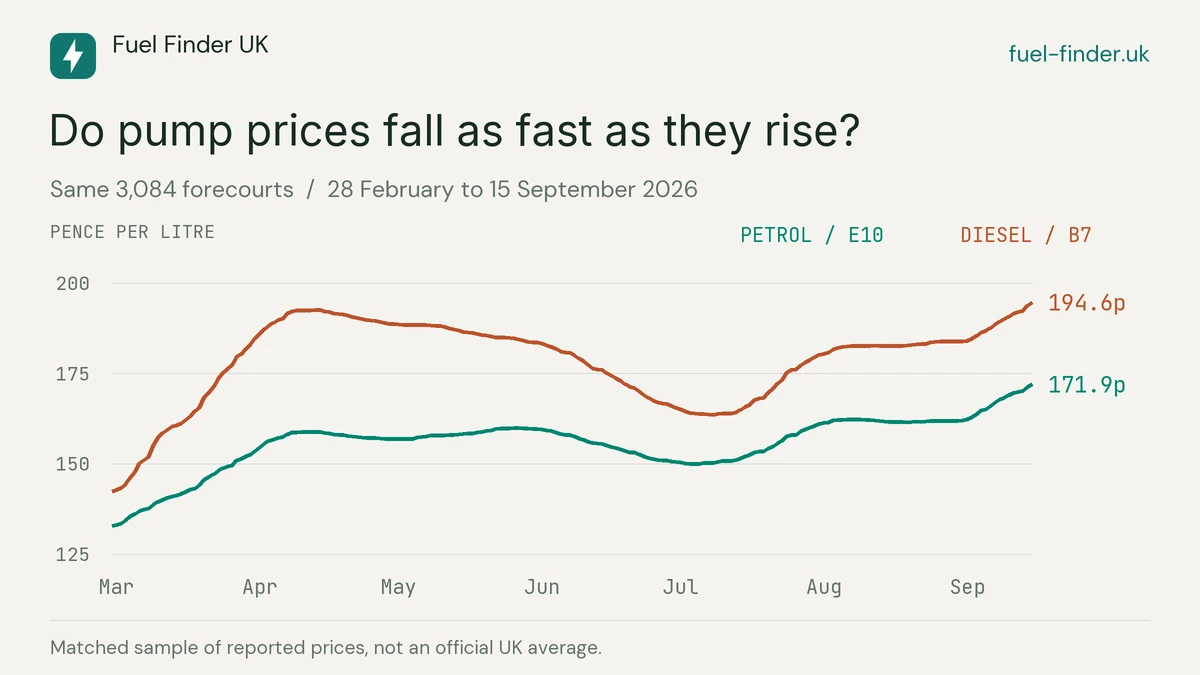
As at 7:14pm BST on 26 September 2026, more than one in four diesel-reporting forecourts in Fuel Finder's eligible sample was charging at least £2 per litre.
In that snapshot, 2,094 of the 7,785 forecourts in the sample were reporting diesel at or above 200p per litre. That is 26.9% of the measured sites.
The equal-station average was 199.22p, while the median forecourt was charging 199.9p. A further 383 sites were already at 205p or more.
These figures do not mean that 26.9% of all diesel sold costs more than £2. Fuel Finder does not have fuel-sales volumes and each qualifying forecourt is weighted equally. They do show that £2 diesel is no longer confined to a handful of unusually expensive locations.
The national average hides a much wider spread
Fuel Finder's current diesel price distribution was:
| Reported diesel price | Forecourts |
|---|---|
| Below 190p | 222 |
| 190p to 194.9p | 890 |
| 195p to 199.9p | 4,579 |
| 200p to 204.9p | 1,711 |
| 205p or more | 383 |
At the measured national average, 55 litres of diesel costs approximately £109.57.
That average is useful for tracking the overall market, but it cannot tell an individual driver what they are likely to pay locally. Road type, retailer and location now make a much larger difference than a few tenths of a penny in the national figure.
Almost every measured motorway site is above £2
Fuel Finder identified 125 forecourts classified as motorway service areas with a current eligible diesel price.
Of those, 122 were reporting diesel at or above 200p per litre. The measured motorway average was 217.05p, compared with 198.93p at non-motorway sites.
That 18.12p-per-litre difference adds approximately £9.97 to a 55-litre fill.
The practical implication is clearer than any national record comparison. Where a safe and convenient alternative is available, filling before joining a motorway can make a substantial difference.
The £2 threshold varies sharply by retailer group
Across diesel-reporting BP, Shell and Esso sites, Fuel Finder measured an average of 200.82p. Approximately 42% of the sites in that group were at or above £2.
The measured supermarket average was 196.14p, with 3.2% of supermarket sites at £2 or more.
The 4.68p difference between those groups is worth approximately £2.57 on 55 litres.
| Retailer | Diesel-reporting sites | Average diesel price | Sites at £2 or more |
|---|---|---|---|
| BP | 1,084 | 201.79p | 46.3% |
| Esso | 1,431 | 200.46p | 43.1% |
| Shell | 851 | 200.18p | 34.4% |
| Morrisons | 339 | 197.29p | 0% |
| Asda | 405 | 196.60p | 11.9% |
| Sainsbury's | 315 | 195.74p | 0% |
| Tesco | 510 | 195.47p | 0% |
| Costco | 22 | 189.58p | 0% |
These are equal-site group averages, not a verdict on every forecourt operated by a retailer. Location, motorway coverage and network composition all affect the comparison.
They also do not prove why a retailer is more or less expensive. Fuel Finder can measure reported pump prices, but it cannot see an individual operator's wholesale purchasing arrangements, operating costs or pricing decisions.
Scotland and southern England show the greatest exposure
Scotland had the highest regional average in Fuel Finder's snapshot at 200.60p, with 42% of measured sites reporting diesel at £2 or more.
The South East averaged 200.36p, while London averaged 199.86p. Northern Ireland remained markedly lower at 194.26p.
The difference between the measured averages in Scotland and Northern Ireland was 6.34p per litre, equivalent to approximately £3.49 on 55 litres.
Looking more locally, and limiting the comparison to postcode areas with at least 20 reporting stations, the highest diesel averages included:
| Postcode area | Reporting stations | Average | Sites at £2 or more |
|---|---|---|---|
| IV | 59 | 203.14p | 54.2% |
| HU | 60 | 201.87p | 55.0% |
| SN | 62 | 201.69p | 54.8% |
| BH | 61 | 201.52p | 68.9% |
| PH | 41 | 201.47p | 51.2% |
A postcode-area average does not mean every local station charges that amount. It does show why the same national headline can feel very different to drivers in different parts of the country.
The BH postcode area, for example, did not have the highest average, but it had the highest proportion of £2 diesel among these five areas. Nearly seven in ten measured BH sites had crossed the threshold.
Forecourts are still repricing upwards
The market had not settled by the time of the analysis.
Fuel Finder examined diesel price-change events recorded during the preceding 24 hours. Changes greater than 10p per litre in either direction were excluded under a stated quality-control threshold. This reduces the effect of corrections and extreme observations, but it may also exclude some genuine unusually large price movements.
After applying that threshold, Fuel Finder found:
- 1,613 diesel price rises
- 51 diesel price reductions
- A median increase of 1p per litre
- 1,599 individual stations recording at least one rise
That is more than 31 recorded increases for every reduction in the filtered data.
Eleven changes were removed by the 10p threshold. Publishing the number excluded makes the effect of that decision visible rather than silently treating every large movement as an error.
A change event is not the same as a daily survey of every pump. An unchanged price normally produces no new event, while one forecourt can change its price more than once.
The comparison therefore describes the balance of recorded price changes, not the proportion of every UK forecourt that increased its price that day. Nevertheless, the imbalance shows that upward repricing remained widespread among stations submitting changes.
What Fuel Finder's prediction engine detected
Fuel Finder also examined seven national diesel forecasts issued from 13 to 19 September that have now reached their evaluation dates.
All seven predicted that the equal-station diesel average would rise over the following seven days. The measured outcome rose in every case, with an average absolute difference of approximately 1.8p per litre between the forecast and the realised change.
The value of these results is that the forecasts were recorded before their outcomes were known. They provide evidence that the engine detected continuing upward pressure during this particular period rather than simply explaining the increase afterwards.
They are not proof that the model can predict every market accurately. The seven forecasts overlap and all come from the same strongly rising episode, so they should not be treated as seven completely independent tests or as a general success rate.
Fuel Finder will continue evaluating predictions against their original station cohorts and simple comparison baselines. Unevaluated forecasts will remain clearly identified as forecasts until their target dates have passed.
Has diesel broken the record?
The RAC reported a national diesel average of 198.32p on 25 September and said its previous record of 199.09p was likely to be surpassed over the weekend.
Fuel Finder's equal-station measure reached 199.22p in this analysis, but the figures are based on different samples and methodologies. They are not directly interchangeable.
Fuel Finder is therefore not presenting its figure as confirmation that the RAC's national record has been broken.
The more useful conclusion is already supported by the underlying distribution: £2 diesel has spread through a substantial part of Fuel Finder's reporting sample, and where a driver fills up can now alter the cost of a tank by several pounds.
What drivers can do
- Check prices shortly before travelling. Rapid repricing means a previously competitive station may have changed.
- Compare several forecourts along the route, not only the nearest one.
- Fill before joining a motorway where practical and safe.
- Consider retailer differences, but check the actual local price rather than assuming every supermarket or branded site follows its group average.
- Look at when a price was reported and confirm the displayed pump price before filling.
Drivers can compare the latest reported prices through Fuel Finder and follow the wider market through the UK Fuel Price Index.
Methodology and limitations
This analysis used 7,785 current public diesel prices eligible for Fuel Finder's UK index at 7:14pm BST on 26 September 2026. Every qualifying forecourt was weighted equally. Invalid, incomplete and ineligible reports were excluded.
The dataset included 1,624 prices updated during the preceding 24 hours, 3,761 within 48 hours and 6,552 within seven days. An older report may still represent an unchanged current price, but motorists should consider its reported time when comparing stations.
Retailer, regional, motorway and postcode classifications use Fuel Finder's current station records. Postcode-area comparisons require at least 20 reporting stations.
The price-change analysis used retained diesel history events from the preceding 24 hours. Each event was compared with the preceding retained price for the same station and fuel. Events without a preceding observation were not counted. Eleven changes greater than 10p per litre in either direction were excluded under the stated quality-control rule.
The forecast results use seven-day national trials recorded before their outcomes. Each outcome compares the same station cohort at the forecast and target times. The seven forecasts overlap and should not be treated as independent evidence of long-term forecasting accuracy.
The analysis is not weighted by sales volume. It does not measure the proportion of motorists buying diesel at each price, establish the cause of an individual retailer's pricing decision or prove that every displayed pump price changed at precisely the same time as its report.