When petrol and diesel prices rise, it seems reasonable to expect motorists to search more actively for a cheaper forecourt.
Fuel Finder analysed more than 1.3 million nearby fuel-price queries made between 12 August and 26 September 2026 to see whether that assumption holds up.
The answer is more interesting than a simple yes.
Across the country, Fuel Finder activity increased sharply as average prices climbed. At a local level, however, areas experiencing the largest increases did not consistently produce the largest increases in query activity.
The evidence suggests that motorists respond to the wider national price environment, and the uncertainty surrounding it, more strongly than they respond to every small local movement.
Prices and attention rose together nationally
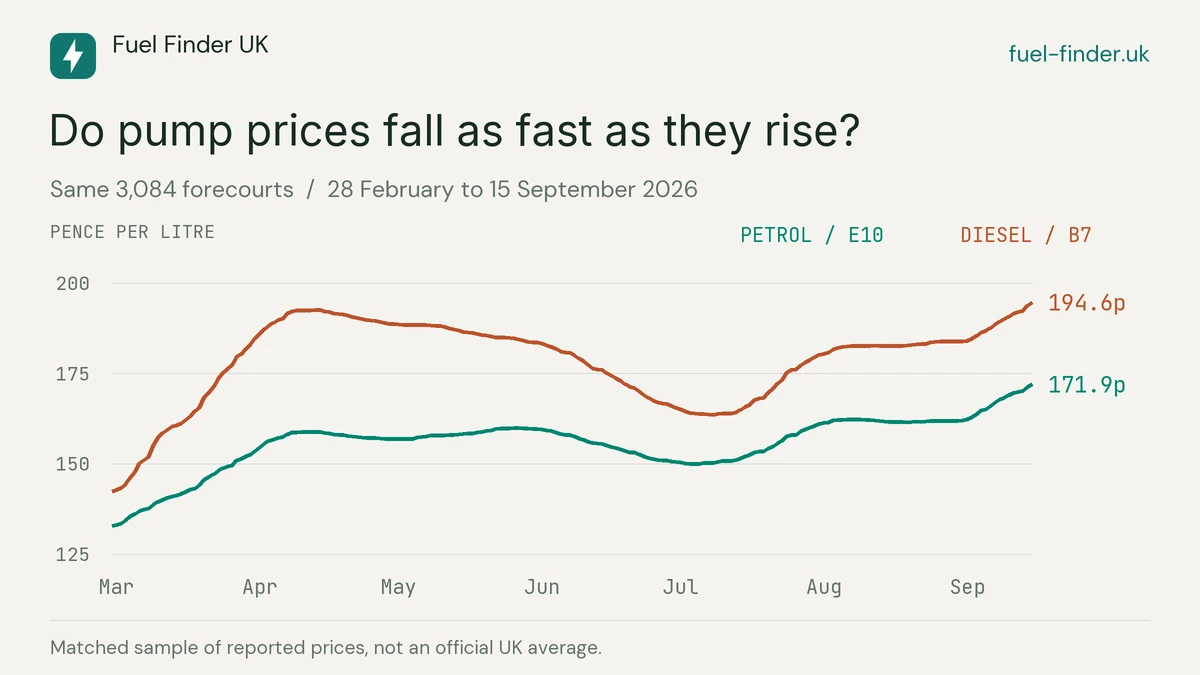
During the study period, the median petrol price shown in Fuel Finder query results rose from approximately 162p to 173p per litre.
Diesel increased from around 184p to 197p per litre.
At the same time, nearby-price query activity within the dataset more than doubled for petrol and came close to tripling for diesel.
On a simple national comparison, prices and query activity moved closely together. The statistical correlation exceeded 0.94 for both fuels during the period.
That does not mean rising prices caused all of the additional activity. Fuel Finder was also attracting more traffic, while news coverage, concern about further increases and changes in journey patterns may all have contributed.
It does show that fuel prices commanded substantially more attention as the national market became more expensive.
The local pattern was very different
If motorists reacted directly to local increases, areas with the sharpest price rises should also have recorded the strongest relative increase in nearby-price queries.
That pattern did not appear.
After accounting for changes in Fuel Finder's overall activity, the measured local relationship was effectively zero for both petrol and diesel. Some areas recorded rising prices and increased attention, but others experienced similar increases without a comparable change in activity.
We also examined more than 200 qualifying local price-rise events at thresholds of 2p, 3p and 4p per litre.
There was no consistent surge in local query activity immediately before, during or after those increases.
This does not mean motorists are indifferent to local prices. It means the size of a local increase, by itself, was not a reliable predictor of how much additional Fuel Finder activity followed.
What could explain the difference?
One possibility is that motorists respond to price rises as a national attention event.
Headlines, social media discussion and highly visible price thresholds can make fuel costs feel urgent. Once that happens, people may start comparing nearby stations even if their own area has not experienced the largest increase.
Absolute prices may also matter more than the rate of change. A move from 168p to 171p could attract more attention than a larger increase from a lower starting point because it crosses a psychologically important threshold.
Some motorists may be checking prices in anticipation of further increases rather than reacting to a rise that has already happened. Others may only notice changing prices when they pass a forecourt or need to fill up.
These are plausible explanations, but the data cannot establish which motivation applies to any individual query.
What motorists can take from the findings
The absence of a predictable local response is a useful result.
It suggests that public attention does not always identify the places where prices are moving fastest. An area attracting relatively little discussion can still experience a meaningful increase, while a nationally prominent price story may encourage checking in places where the local movement has been less severe.
For motorists, the practical lesson is straightforward: national averages and headlines describe the wider direction of travel, but they do not reveal the full range of prices available locally.
Checking nearby forecourts with Fuel Finder remains worthwhile, particularly during a rapidly changing market. You can also follow the wider market through the UK Fuel Price Index.
What the study does not claim
Fuel Finder records nearby fuel-price queries, not fuel purchases.
A query may begin with a typed location, device location, map interaction or refreshed set of results. It should not automatically be interpreted as a new person deliberately searching for fuel.
The analysis therefore measures attention and comparison activity. It cannot tell us whether someone subsequently changed station, delayed filling up, purchased less fuel or reduced their driving.
The national relationship is also descriptive rather than causal. Prices, media coverage, Fuel Finder's reach and other market conditions changed during the same period.
We have deliberately not presented the results as proof that price rises caused a specific change in consumer behaviour.
How the analysis was conducted
The study examined more than 1.3 million qualifying petrol and diesel queries across over 100 UK postcode areas.
Results were aggregated geographically and analysed without identifying individual motorists or journeys. Low-volume comparisons, invalid locations, implausible prices and obvious automated activity were excluded.
Local activity was measured relative to total Fuel Finder activity so that general growth in use of the service did not automatically appear as increased interest in every area.
Local price changes were compared over seven-day periods. Separate event studies examined activity surrounding increases of at least 2p, 3p and 4p per litre.
The price measure represents the typical average price among stations returned in nearby Fuel Finder results. It is not a sales-weighted measure of every litre purchased within an area.
Attention rises nationally, but local behaviour is more complicated
The study began with a simple expectation: larger local price rises would lead to more local fuel-price checking.
Fuel Finder's data does not support that conclusion.
Instead, it points to a broader behavioural response. When fuel becomes more expensive and the market attracts national attention, motorists appear more inclined to compare prices. Precisely where that attention increases is influenced by more than the local price movement alone.
That distinction matters.
Search activity can provide a timely indication of public attention and uncertainty, but it should not be treated as a direct measure of purchasing decisions or as a reliable predictor of the next local price rise.
Sometimes the most useful result is the one that challenges the obvious assumption.